I never thought I’d say this, but I miss being an SRE in the Old Days 1.
1.
No matter how much code agents write for me today, I’m still the directly responsible individual for every bug. So when things go wrong, I still have to crack open my laptop2.
But unlike the old days, I don’t know every line of code! I’m more like a manager on call – yikes.
On call with AI: slower, more stressful
- Get paged in Slack
- Ack the page
- Immediately copy+paste the page into my coding agent with “omg what is happening!!”
- Agonize as it methodically investigates the issue
- Steer random context into the chat as it goes
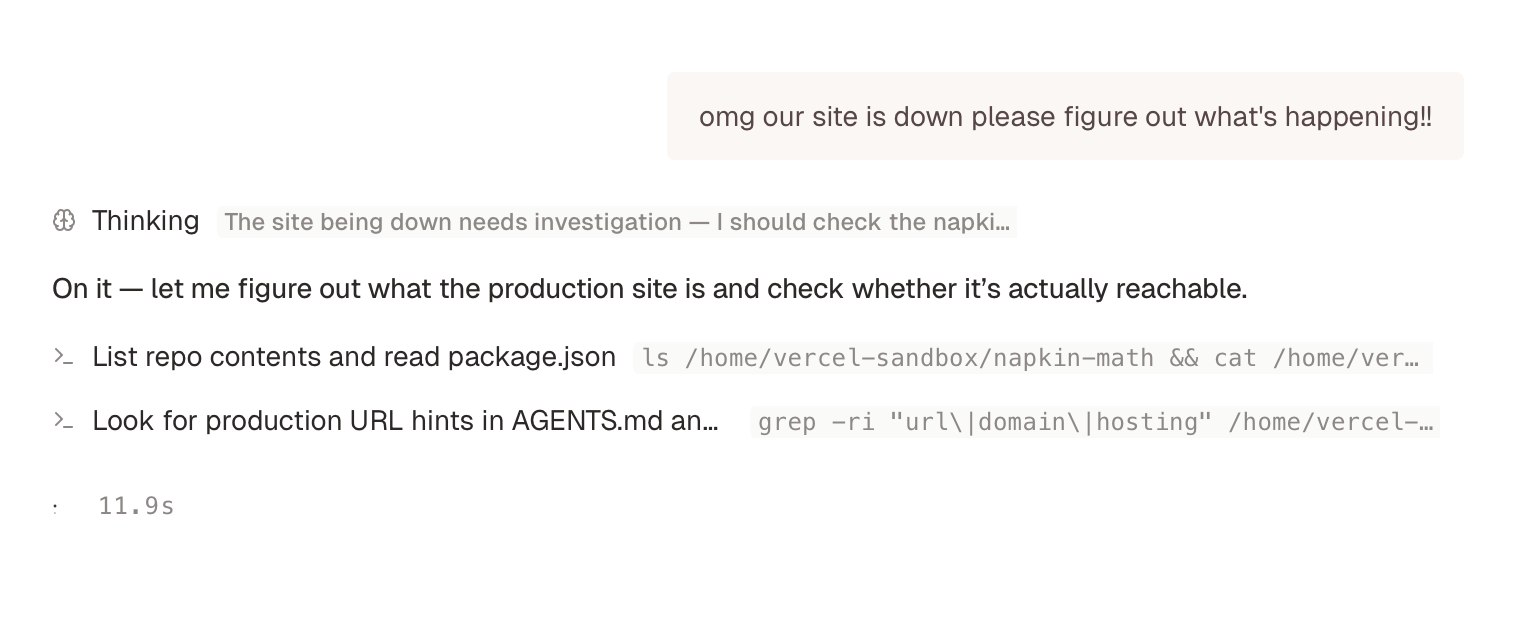 make no mistakes
Generally with enough tokens and time the agents resolve the outage, but:
-
Outage comms are worse. I’m just pasting random hypotheses from my agent into the Slack thread. I don’t have as good of a sense of the ETA to resolution.
-
The agent doesn’t work in outage mode by default. The default coding agent behavior is to investigate, then make a speculative forward fix. That’s the wrong approach during an outage! We should mitigate first with the lowest-risk change – roll back! turn off the flag! – rather than shipping more new code with less testing.
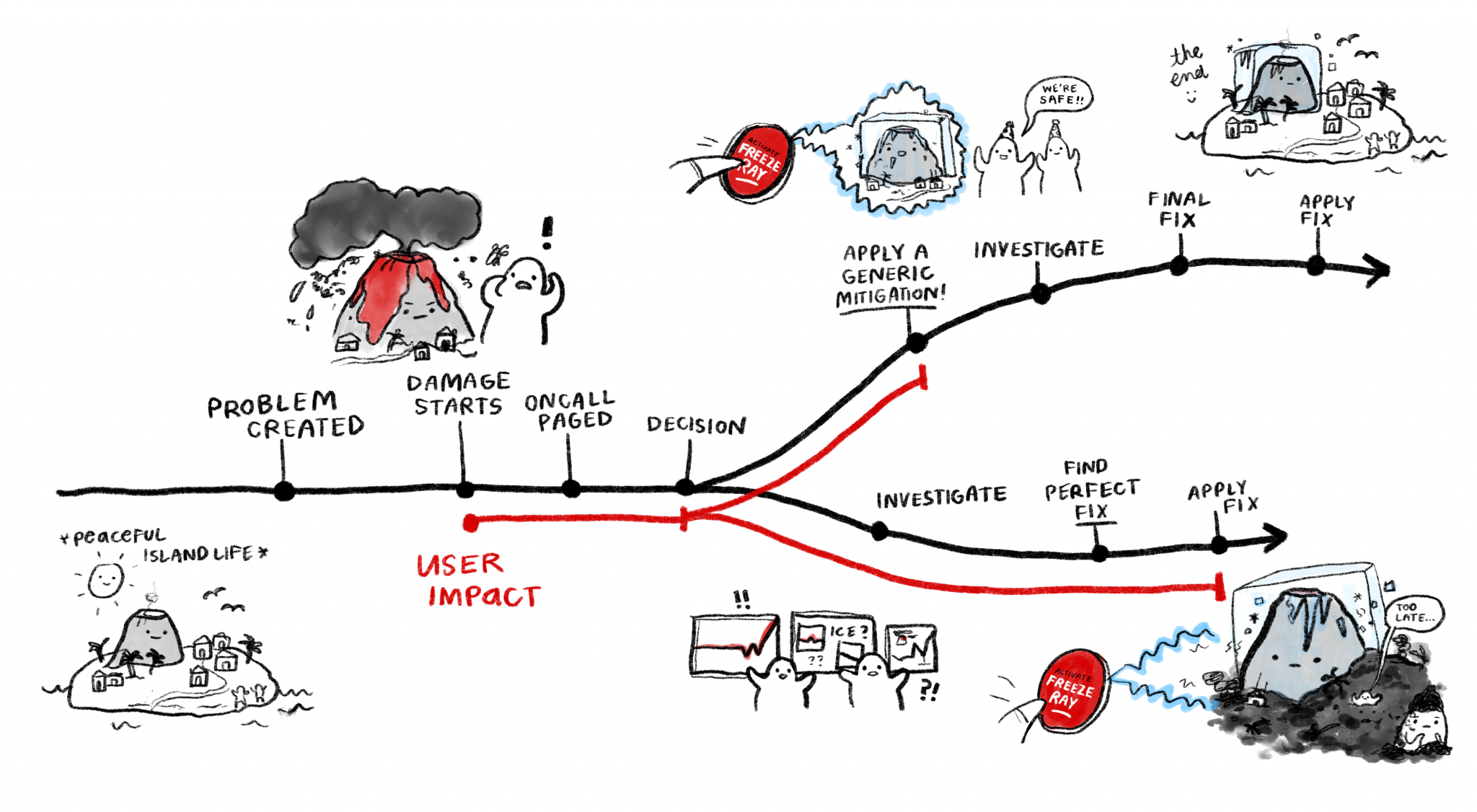
Source: Generic Mitigations by Jennifer Mace, O’Reilly Radar
After a few sweaty incidents, we’ve changed how we build to make being on call easier with agents.
Feature flag everything
The simplest tip I got from Alon to ship faster was to feature flag everything and test in prod. When starting a new project I build feature flag support right away. Feature flagging is an acknowledgment that I know so little about the code that I need a big red switch to manage it.
This was mostly a mindset change to remember to prompt “…and put this behind a
flag”.
Beyond that, a line in AGENTS.md like “we use PostHog for feature flags” and a file
called features.ts are enough.
We don’t ask the agents to decide what to feature flag themselves yet. Do you? Should we?
Write a doc/skill explaining how you do release management
We built the Napkin Math iOS and Android apps in the YC Spring 2026 batch using Expo with React Native.
Expo’s magic trick is the “over-the-air update” – a React Native app is built with a native layer and an update layer of JavaScript and assets that can be updated over-the-air (OTA) without the user needing to visit the App Store.
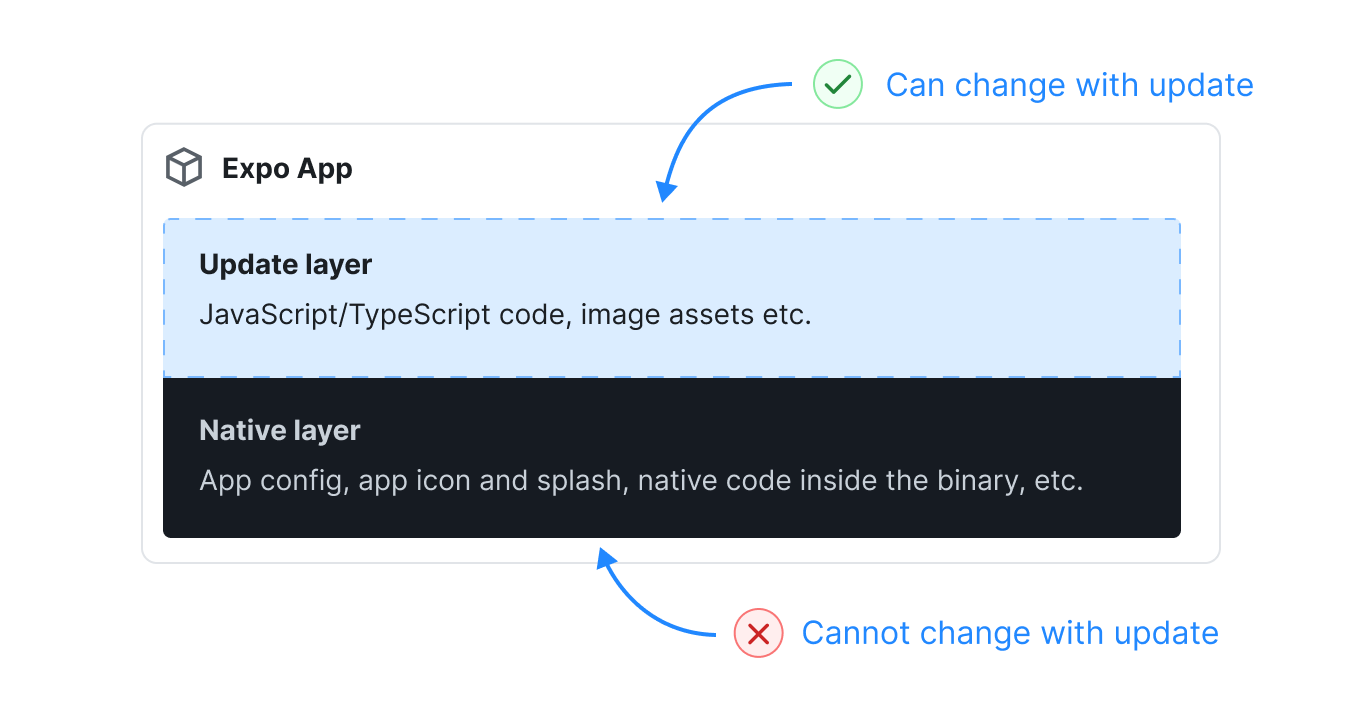
Source: How EAS Update works, Expo Docs
OTAs can be super useful to mitigate an outage if done right!
More on how we did Expo updates
We generally followed Expo OTA best practices.
We used the Expo appVersion policy with the release
branch pattern from trunk-based development.
There’s one Git branch per runtime version.
Suppose main targets runtime version 1.0.17 and a PR lands a breaking native
change:
- The PR with the breaking native change bumps the app version to
1.0.18. - Right before merging, we branch
1.0.17-otaoff ofmainand push a final OTA to1.0.17users. - Merge the PR. After the merge, updates published from
maintarget1.0.18. - If there’s a JavaScript bug introduced in
1.0.17we need to mitigate for users on both versions, we fix it onmain, cherry-pick it onto1.0.17-ota, and then push OTAs from both branches.
After I explained this release management system to agents mid-outage a few times, it was helpful to just write a doc into the repo. I’d recommend you do the same! Everyone’s release process is a different special snowflake, so it’s probably not just In The Weights.
Recursive self-improvement: postmortems and runbooks
I confess: we haven’t done this one yet! Have you?
A few times now we’ve “fixed” a bug, only to have it crop up again. The agents fixed some narrower version of the issue or didn’t test the right thing before declaring victory.
In a repeat outage it’s stressful to watch the agent plod down the same investigation/discovery path, wasting tokens and time. I don’t want them to root-cause the same issue twice!
I’m thinking of adding a simple recursive self-improvement loop for the repo where we have:
docs
├── postmortems
│   └── 2026-08-18-photo-upload-failed-....md
└── runbooks
    └── expo-updates.md
I’m not sure what threshold for notability I’d use to warrant a postmortem or runbook except “when I say so”. But I’d want these to be primarily agent-readable (not explicitly designed to be human-readable) docs.
Is this cope?
How much should we change how we build software to adapt to coding agents, and how much should we just wait for the next model release?
My thought is:
- if it’s generically making the agent “code better”, it’s probably gonna be in the weights. That’s why I won’t write a generic “on-call” skill which would basically be “follow the Google SRE book”.
- if it’s about how your specific team/company does things, might as well make it legible to agents by writing it down
I still hold tightly (too tightly?) to some aspects of software development.
Maybe someday soon AI will replace my SRE job and we’ll delete all the docs and walk into the sunset building freely :)
Related reading
I read these after writing the above post. These writers are thinking along similar lines!
Compound Engineering: How Every Codes With Agents A four-step engineering process for software teams that don’t write code https://every.to/chain-of-thought/compound-engineering-how-every-codes-with-agents AI demands more engineering discipline. Not less
If you lived through the shift from handcrafted server pets to immutable infrastructure, you should sense something oddly familiar about what's happening now.
https://charity.wtf/p/ai-demands-more-engineering-discipline
AI demands more engineering discipline. Not less
If you lived through the shift from handcrafted server pets to immutable infrastructure, you should sense something oddly familiar about what's happening now.
https://charity.wtf/p/ai-demands-more-engineering-discipline
 Stop trying to review AI's code faster: bet on rollback instead | Rootly
https://rootly.com/blog/stop-trying-to-review-ais-code-faster-bet-on-rollbacks-instead
Stop trying to review AI's code faster: bet on rollback instead | Rootly
https://rootly.com/blog/stop-trying-to-review-ais-code-faster-bet-on-rollbacks-instead
-
Pre-AI. ↩
-
Or chicken farm on my phone ↩